Lantern Grid Memory Strategy: Chunk Patterns Instead of Counting Cells
A practical memory guide for Lantern Grid, focused on chunking, rhythm, and visual anchors.
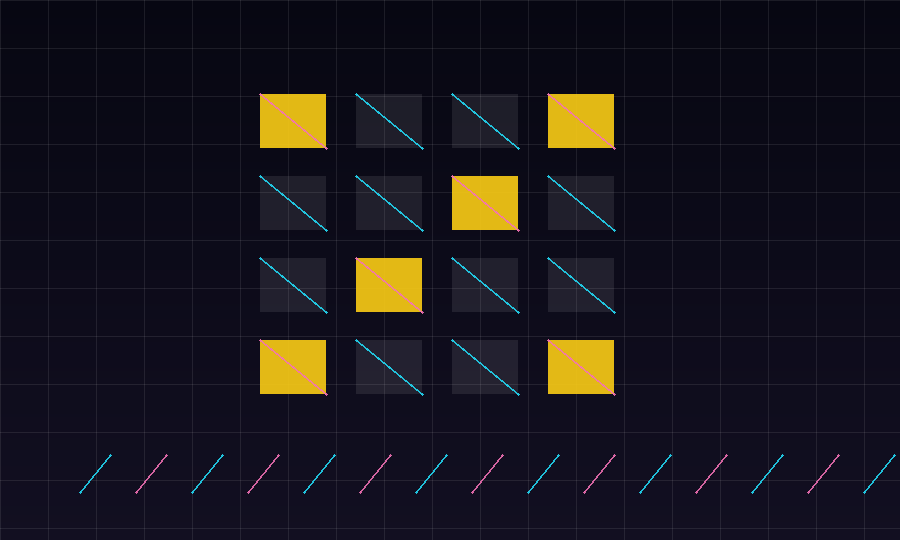
Lantern Grid is a memory game, but raw memory is not the whole story. Strong players do not count cells one by one. They group positions into shapes, corners, and movement rhythms.
Use visual chunks
A 4 by 4 grid has sixteen cells. That sounds like a lot until you break it into chunks:
- Four corners
- Four center-adjacent cells
- Two top pairs
- Two bottom pairs
- Diagonal shapes
When a pattern lights up, name the shape silently. “Top left, center, bottom right” is easier to remember than “cell one, cell six, cell eleven.”
Remember direction
Sequences often feel easier when treated as motion. Instead of memorizing separate points, imagine a line moving through the grid. Does it travel down? Does it bounce from corner to center? Does it zigzag?
Direction gives the brain a path to replay.
Tap after the full sequence
Do not start tapping before the sequence finishes. Early input makes it harder to store the final cells. Watch the complete pattern, take a short beat, then reproduce it.
This is the same habit used in many rhythm and memory games: receive first, answer second.
Build anchor cells
Choose four anchor cells before you play: top-left, top-right, bottom-left, bottom-right. When a lit cell appears near an anchor, describe it relative to that anchor. “One below top-right” is easier than an abstract grid number.
Anchors are especially useful on mobile screens where cells are smaller.
Practice target
Start with accuracy before speed. If you can repeat three-cell sequences cleanly, move to four. If four becomes comfortable, start focusing on response time.
The important metric is not only best score. It is how often you can recover after a miss and return to calm pattern reading.
Build a naming system
The fastest way to improve is to stop treating every pattern as new. Give common shapes a name before the round starts. A vertical line can be “rail.” A corner-to-center movement can be “hook.” A diagonal can be “fall.” These names do not need to be official or clever. They only need to be consistent.
For example, a pattern that touches top-left, middle-left, and bottom-left can become “left rail.” A pattern that touches top-right, center, and bottom-left can become “down diagonal.” Once a name exists, the brain stores one idea instead of three separate cells.
This is why two players can see the same sequence and feel different levels of difficulty. One player sees four unrelated flashes. The other sees a familiar shape with one extra step.
Use misses as data
A miss is most useful when you can describe it. Did you forget the first cell, the middle cell, or the final cell? Did your hand cover the board? Did you tap too early? These are different problems.
If you forget the first cell, spend more attention on anchor points. If you forget the middle cell, use direction words. If you forget the final cell, wait longer before tapping. If you tap wrong even when you remember the pattern, the issue is input accuracy rather than memory.
Keep rounds short
Lantern Grid works best when practice is short and focused. Five careful rounds teach more than twenty rushed rounds. After a few misses, pause, reset your anchor cells, and restart with a smaller goal.
The game is designed for visible improvement. A player should be able to say, “I used to count cells, now I see shapes.” That shift is more important than one high score.
Lantern Grid is intentionally minimal. The simplicity makes the learning visible: chunk, trace direction, wait for the full sequence, then tap with intent.
That repeatable loop is what makes a short memory game worth practicing beyond the first few rounds.