Signal Drop Timing Guide: Clean Landings Beat Fast Drops
Learn how lane timing works in Signal Drop and why patient packet drops score better than rushed inputs.
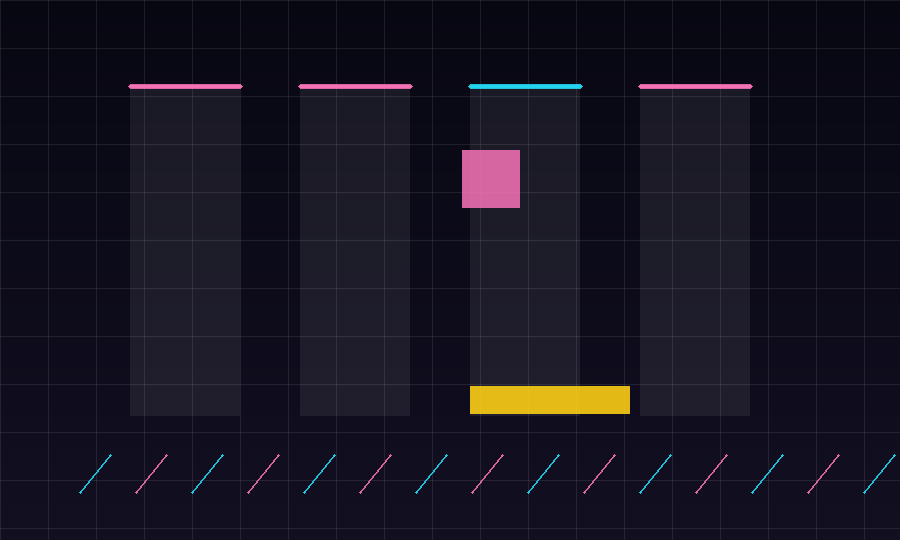
Signal Drop is a timing game with a simple rule: choose the lane before the packet reaches the gate. The board is not trying to hide information. It is testing whether you can wait long enough to make the clean choice.
Read the gate first
The yellow gate cycles across the lanes. If you only watch your packet, you will move late. Start by watching the gate rhythm, then move the packet lane before the drop reaches the scoring zone.
The useful pattern is: gate, lane, drop. Look at the gate, choose the lane, then let the packet fall.
Avoid last-second corrections
Last-second corrections create most misses. A rushed left-right-left input often leaves the packet one lane away from the gate. Move once, commit, and let the packet resolve.
If you choose the wrong lane early, it is sometimes better to accept the miss and reset your rhythm than to create a second miss by panicking.
Use the center as a staging area
The center lanes are safer because either edge is only one or two moves away. If you drift to an outside lane without a reason, the next gate may require a longer correction.
After each landing, return toward the middle unless the next gate is already obvious.
Score goals
Signal Drop rewards streaks of clean landings. For practice, use these targets:
| Score | Skill signal |
|---|---|
| 36 | You can read basic lane timing |
| 72 | You can recover after a miss |
| 120 | You are planning one gate ahead |
The game speeds up mentally before it speeds up mechanically. When the board feels fast, breathe, watch the gate, and make fewer inputs.
Why this game is short
Signal Drop is designed for quick sessions. The goal is not a long campaign; it is a repeatable timing loop that can be understood in one minute and improved over several runs.
Clean landings beat fast drops because the scoring system is built around accuracy. The player who waits half a beat usually beats the player who presses twice as often.
A simple timing drill
Play three runs where you are not allowed to move more than once per packet. This drill removes the habit of double-correcting. If the gate moves away after your choice, accept the miss and read the next gate. The point is to build clean decisions, not perfect outcomes.
After three runs, return to normal play. Most players notice that the board feels slower because their hands are no longer adding extra noise. The lane choice becomes clearer, and misses are easier to understand.
What to watch on mobile
Mobile play changes the timing slightly. A thumb tap can feel slower than a keyboard press, and the smaller screen can pull your eyes toward the falling packet. To compensate, decide one beat earlier. Move lane before the packet is near the scoring zone.
If you keep missing by one lane, do not speed up immediately. First check whether you are watching the gate late. Many “slow reaction” problems are actually late reading problems.
How to review a run
After a run, ask one question: did the miss happen because of reading, movement, or panic? Reading misses happen when you choose the wrong lane. Movement misses happen when you know the right lane but arrive late. Panic misses happen when you correct twice and lose the rhythm.
Each answer has a different fix. Reading needs more gate watching. Movement needs earlier commitment. Panic needs fewer inputs. This short review turns each run into practice instead of repetition.
The goal is steady timing language: see the gate, choose the lane, let the packet resolve, then review the result.